


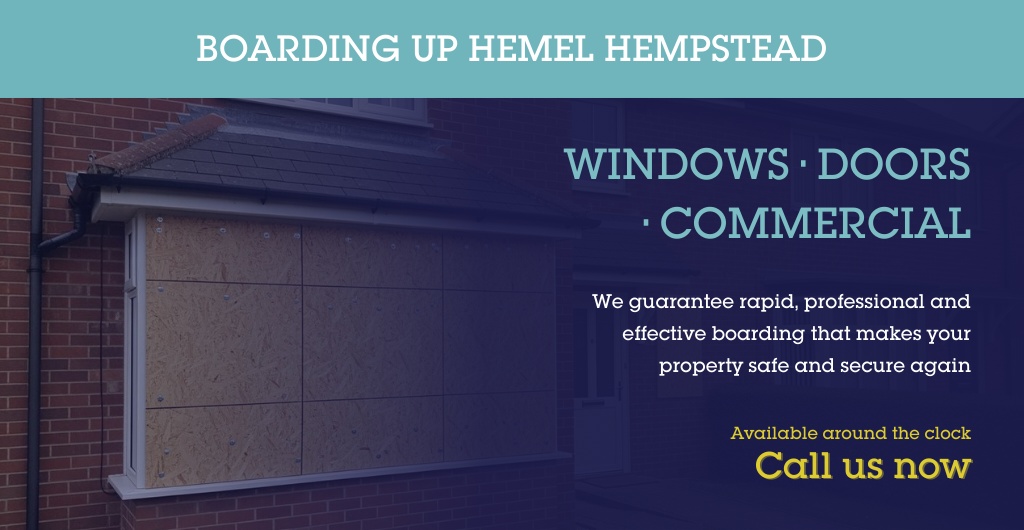
Boarding Up for Vacant Property in Hemel Hempstead (HP1–HP27)
A vacant property can go from “quiet” to “at risk” very quickly. Empty homes between tenancies, probate properties, shut-down retail units and void council stock can attract opportunistic break-ins, vandalism and squatting—especially if there are obvious signs nobody is living there.
We provide vacant property boarding up in Hemel Hempstead and across the HP postcode area (HP1–HP27). Whether you need emergency boarding up after a break-in or planned, medium-term protection while you arrange repairs or a sale, we’ll help you secure the property properly and document everything for your records or insurer.
If you need urgent help, go straight to our emergency boarding up page or call: 01442 502 589.
Why vacant properties need a different approach
When a building is empty, the risks change:
- There’s often no one to notice a smashed window, forced door, or roof damage until it gets worse.
- Once an opening exists, you can get repeat targeting—especially if the property looks like an easy return.
- Weather can cause serious secondary damage: rain through a broken window or missing roof tile can quickly lead to damp, warped flooring and blown plaster.
- Many vacant buildings need a higher security level than a normal “make safe” because they may be unattended for weeks.
Our aim is simple: make the building safe, reduce the chance of re-entry, and leave you with a clear plan for what happens next.
For background on what boarding up involves (and what it doesn’t), see what is boarding up.
Typical vacant property scenarios we handle in the HP area
Vacant properties crop up in lots of everyday situations. Common call-outs and planned jobs we see across Hemel Hempstead and surrounding HP postcodes include:
Between tenancies (landlords and letting agents)
A void period is a window of opportunity for intruders—especially if curtains are down, post is building up, or contractors are coming and going. We’re often asked to:
- board up a broken window after a viewing or attempted break-in
- secure a rear access door that’s been forced
- install stronger temporary security while refurbishment is underway
Landlords often need quick documentation and itemised invoices—especially if costs may be reclaimed later.
Probate and unoccupied family homes
These can sit empty while legal matters are handled. Break-ins here are frequently about quick wins—tools, copper, or anything left behind. We can make safe damaged entry points and advise on next steps for longer-term protection if the property won’t be visited regularly.
Vacant shops, offices and light industrial units
Empty commercial premises can be targeted for metal theft, vandalism, or simply because they look “open”. If you’ve had a smashed window or forced door, we can shopfront boarded up solutions and heavier-duty access control.
If the damage is on a commercial frontage, see shopfront boarding.
Post-incident vacant property (after fire, flood or storm)
Sometimes a building becomes vacant because of an incident. The property may be unsafe to occupy but still needs securing quickly to prevent further damage or theft.
- After storms: openings, missing panels, or unsafe glazing
- After fire: exposed doors/windows once the emergency services have finished
- After flood: swollen frames that don’t lock and compromised rear access
We can secure openings, but we’ll also be candid if the surrounding structure is too unstable for non-destructive fixing—if that happens, we’ll talk you through options before proceeding.
Related guidance: storm damage boarding and fire damage securing.
How we secure vacant properties (methods and materials)
Vacant property boarding up isn’t just about covering a hole. It’s about choosing a method that fits the risk level, duration, and condition of the building.
1) Window boarding for empty buildings
For most windows we use:
- 18mm exterior-grade plywood for robust, longer-lasting temporary boarding
- 12mm OSB for smaller openings or lower-risk internal/short-term applications (where suitable)
We cut boards to size, position them to cover the full vulnerable area, and fix them using methods suited to the frame and substrate. Where the property is likely to be unattended, we prioritise anti-tamper fixings that can’t be easily removed from outside.
If you specifically need to board up a broken window after vandalism or a break-in, our window boarding in Hemel Hempstead page explains options in more detail.
2) Door boarding and access control
A vacant property often fails at the door, not the window—especially if the existing door has been forced and the frame is split or the lock ripped out.
Depending on the condition, we may:
- board up a door opening securely (short-term, after forced entry)
- stabilise and board if the surrounding frame is damaged
- discuss stronger medium-term options where appropriate
More detail here: door boarding.
3) Temporary steel doors (for medium-term security)
If you need controlled, lockable access for weeks (contractors, surveyors, letting agents), a temporary steel door can be a better fit than repeated boarding and unboarding.
It’s commonly used when:
- the property will be visited regularly, but not occupied
- the original door/frame is too damaged to secure reliably
- you’re managing a void and want a more durable deterrent
4) Security screens for longer-term voids
Where a building is empty for longer periods, a boarded opening can become a target in itself. Security screens (often used on voids) can provide a stronger, more repeatable solution than timber boarding alone.
We’ll explain what’s realistic for your building and budget—there’s no one-size-fits-all answer.
5) Roof and high-level openings (skylights, rooflights)
Vacant properties are also vulnerable overhead. A slipped panel or broken rooflight can let in rain, and access can be trickier (and riskier).
If you suspect roof-level damage, see roof boarding. We’ll talk you through access and safety considerations on the phone before attending.
Our step-by-step process (what happens when you call)
Whether it’s an emergency boarding up call-out or a planned job for a vacant property, the process is straightforward:
-
You call and describe what’s happened
Tell us what’s damaged (window/door/shopfront/roof), whether the building is safe to approach, and whether anyone is on site. -
We give a realistic ETA and ask the right questions
We don’t promise fixed arrival times—workload and conditions vary—but we prioritise urgent calls and will tell you what’s achievable. -
On arrival: assess, then secure
We’ll check the frame/substrate, choose the most suitable material (plywood/OSB/other method), and install fixings to reduce the chance of removal from outside. -
You receive clear documentation
Where helpful, we can provide:- time-stamped photos of the secured areas
- an itemised invoice and work statement suitable for property files or insurers
If you’re dealing with an insurer, our insurance claims guidance explains what documentation is commonly requested.
Vacant property “make safe” advice while you’re waiting
If you’re stood outside a property in HP1–HP27 right now with a damaged opening, these steps usually help:
- If there’s any sign of intrusion, call the police first and don’t go inside. Keep your reference number.
- Don’t try to clear broken glass with bare hands. Keep people away from the area (especially neighbours, children, pets).
- Take photos if it’s safe—wide shots and close-ups of the damage and any tool marks.
- If there’s a smashed window, avoid taping plastic sheeting tightly across it from the outside—temporary coverings can act like a sail in wind and make the damage worse.
- If the property will remain vacant, consider removing obvious temptations (tools, loose metals, ladders left on site) once it’s safe to do so.
For urgent attendance, use emergency boarding up or call 01442 502 589.
Extra considerations for landlords, managing agents and facilities teams
Vacant property work is often about coordination. If you’re managing multiple sites or you’re not local to Hemel Hempstead, we can help with practicalities that reduce back-and-forth:
- Access arrangements: keyholding, tenant/agent attendance, or contractor handover
- Repeat visits: if you need to unboard for glazing repairs and re-secure afterwards
- Risk level matching: short-term temporary boarding vs longer-term solutions like temporary steel doors
- Record keeping: photos and work statements for audit trails
We’re fully insured, and our technicians are DBS-checked—important when you’re sending someone to a residential street, an empty flat block, or a sensitive commercial site.
Vacant property boarding up across Hemel Hempstead and HP postcodes
We cover Hemel Hempstead and the wider HP region (HP1–HP27). Vacant properties range from town-centre flats and empty shop units to rural homes and edge-of-town industrial estates—each needs a slightly different approach.
If you’re looking for a more local page, these may help:
You can also view our wider coverage via the areas we cover page.
FAQs: vacant property boarding up in Hemel Hempstead
Do you provide emergency boarding up for an empty house in Hemel Hempstead?
Yes. If a vacant house has a smashed window, forced door, or other exposed opening, we can attend to make safe and secure the property. For urgent help, see emergency boarding up or call 01442 502 589.
What’s the best option if the property will be empty for weeks?
It depends on the risk level and access needs. For short-term gaps, strong plywood boarding with anti-tamper fixings may be enough. If you need repeated access for contractors, a temporary steel door can be more practical than boarding/unboarding.
Can you board up a door if the frame is damaged?
Often, yes—but the method depends on how compromised the frame and surrounding brickwork/timber are. If non-destructive fixing isn’t safe or reliable, we’ll explain the options before any work starts.
Is boarding up covered by insurance for vacant properties?
Sometimes, but policies vary widely—especially for unoccupied buildings. Your insurer may ask when the property was last occupied and what security measures are in place. We can provide photos and an invoice/work statement, but we’re not loss adjusters. More guidance is on our insurance claims page.
I’m a landlord in HP1/HP2—can you help between tenancies?
Yes. Voids between tenancies are a common reason for planned boarding or upgraded security. We can secure vulnerable windows/doors and advise on the best approach for the length of the void.
What if I only need one window boarded after vandalism?
That’s fine. Many jobs are single openings—especially ground-floor side windows or rear kitchen windows. If you need to board up broken window damage quickly, see window boarding in Hemel Hempstead.
Will boarding up stop further break-ins?
It reduces risk significantly, but no physical security is a 100% guarantee. The goal is to remove easy access, deter opportunists, and prevent weather ingress. For higher-risk voids, we’ll discuss more robust options than basic temporary boarding.
Can you coordinate with a glazier or other contractor?
Yes. We regularly secure first, then return (if required) once repairs are ready. If you tell us the expected repair timeline, we’ll help you choose a method that makes the follow-on work easier and avoids unnecessary cost.
Helpful Links
- emergency boarding up
- window boarding in Hemel Hempstead
- door boarding
- shopfront boarding
- roof boarding
- insurance claims
- pricing information
- contact us
Need to secure a vacant property now or plan protection for a void?
Call 01442 502 589 or email us for a free, no-obligation quote.
